
What promises do you make in your working life ?
Do you start with Money, Carbon, Cost, Comfort or simply compliance?
Who do you make them to (senior management or all building users equally), compliance officers, human resources , the union etc etc?
- and why should they believe you ? !
My friend +William Mougayar recently wrote a post Introducing Product-Value Alignment at Startup Management.org - it taught me a few things and I liked, for example, his definition of a value proposition :
"the most convincing promise you make to your users, customers, and prospects."
Naturally this applies to energy managers although William writes for entrepreneurs and Venture Capitalists - How so? ...
The reason is simple - any energy manager is driving change in an existing environment and must operate very much like the manager of a startup company. To achieve change disrupts, and disruption can be a great thing, but change is risky!
So energy managers can be thought of as (and to an extent should be treated like) entrepreneurs, where innovation involves both risk and good rewards for success
Many engineers during their childhood learned from a simple idea:
"If it can be fixed - break it !"
Matching energy demand and supply (compensation)
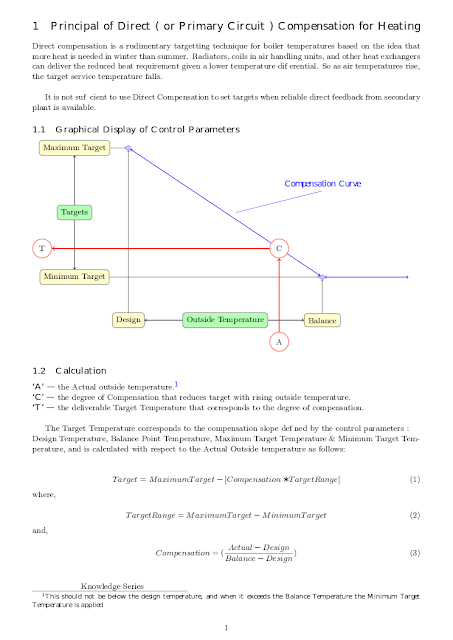
I just added an brief entry to the kWIQly resources page which will help anyone wanting to understand the basics of how direct compensation can be implemented mathematically. Do feel free to use it in energy management or building services course materials etc.
However, more important for energy managers is knowing why and when to use compensation and more specifically its' superiot lesser known cousin, direct compensation.
The emphasis of this post is not about how it works, but why, the particular benefits and pit-falls, and how you can improve on it.
However, more important for energy managers is knowing why and when to use compensation and more specifically its' superiot lesser known cousin, direct compensation.
The emphasis of this post is not about how it works, but why, the particular benefits and pit-falls, and how you can improve on it.
 |
| Compensation Is a key means to save energy |
Definition of Temperature Compensation
Compensation is a strategy to save energy in buildings and is a principle strategy widely used to define target flow temperatures for most Variable Temperature Zones that may support Fan-Coils, VAV units radiators etc.Generic specifications - What the ?!*k
Over the years I have written a few control strategy specifications for buildings.
By the way - the pictures are some buildings where I have worked on controls specifications over the years (they have no real purpose - but nice photos break up the words quite nicely don't you think?).
On more than one occasion I have been asked to write a "generic specification", which does sound really quite stupid.
By the way - the pictures are some buildings where I have worked on controls specifications over the years (they have no real purpose - but nice photos break up the words quite nicely don't you think?).
 |
| St Johns Cambridge |
Google Energy Waste Search Engine
It doesn't exist yet, but certainly a search for waste is the job of any energy manager. And it's valuable.
There are some reasons that explain why it doesn't exist, and some hints as to where it might come about.
Food and Energy Waste are Similar
Lets consider a very simple idea - Food provides energy so its very like oil, or gas or sunshine.
When we talk about energy consumption - that usually means what we end up paying for. But let' take a closer look...
There are some reasons that explain why it doesn't exist, and some hints as to where it might come about.
Food and Energy Waste are Similar
Lets consider a very simple idea - Food provides energy so its very like oil, or gas or sunshine.
When we talk about energy consumption - that usually means what we end up paying for. But let' take a closer look...
 |
| There's what you pay for... |
 |
| there's what you eat... |
Between a Rock and a Hard Place
The typical energy manager has two conflicting drivers that meet to form a single objective.
The conflicting drivers are naturally the inputs.
A) What is being done
B) What it is costing
Note "what is being done" is really producing output eg "widgets manufactured" or"meals served" but this is an input to the energy management perspective - Our energy manager reads it from a screen.
 |
| Between a Rock and a Hard Place ? |
The conflicting drivers are naturally the inputs.
A) What is being done
B) What it is costing
Note "what is being done" is really producing output eg "widgets manufactured" or"meals served" but this is an input to the energy management perspective - Our energy manager reads it from a screen.
Subscribe to:
Posts (Atom)