As we have seen degree-day calculation example it is not calculating degree-days that is the problem. Much harder is getting a reliable source of weather data.
There is the ideal which explains why we need a pragmatic solution
For synoptic and climatological meteorology, the temperature required is a representative one of the 'free air' conditions over as wide an area surrounding the observing point as possible, with an internationally agreed height (for the thermometer bulbs, sensors etc.) of 1.25 m above local ground level. A fixed height must be specified, because vertical temperature gradients can be intense: for example on a clear, calm night or around the middle of the day with strong solar heating.
The best site for a screen, or thermometer shield for a land station is therefore over level ground, freely exposed to the sun and wind, but not sheltered by buildings, trees, bushes etc. The temperature sensor must be shielded from direct sunshine (hence a screen or shield) and precipitation (or a dry bulb becomes a wet bulb), and there must be a good circulation of air around the bulb/sensor head. If you have a garden, then the 1.25m above ground level can usually be met with ease. What it usually problematic is gaining sufficient clearance from adjacent buildings, trees etc.
The screen/shield should be positioned over grass (or less preferably, but still acceptable, loose soil), but not compacted soil, tarmac or concrete, as these media absorb and radiate solar energy strongly, and affect the readings quite significantly.
The bottom line is that the weather station should not be near a building - making it rather difficult to achieve if linked to a building management system
Pragmatically, there are three approaches of which one is reliable, one dreadful, and one relies on luck. First let's reject the "dreadful method".
Using your own local weather data
Just because sticking a weather temperature out of a window and calculating the degree-days using your Building Control System is easy AND VERY LOW COST - It does not make it cost effective.
 In fact, though commonplace it is unbelievably stupid!!! - Why ? - When doing energy management we are seeking to validate decisions in a real context.
If we look at the real context of "demand" as determined by a potentially broken system, we may see that software does "exactly what it should" given the inputs. We need to validate the inputs !
Using a free independent source of reliable weather data
This is the one that relies on luck. Maybe you live next to an air-field. Air fields and weather conditions have an obvious and important relationship.
Otherwise the typical distance between reliable weather stations is so great to make it meaningless for all but the broadest of analysis (eg. in the UK with a very much higher than average station density the typical spacing averages over 40km).
So if you live near one of the worlds Metar stations http://www.degreedays.net/ can help you (except if you believe that you building changes behaviour between day and night (many do)
Dr Russel Layberry provides some data (weekly resolution via teh Environmental Change Institute in Oxford
http://www.geog.ox.ac.uk/~rlayber/world_weekly_degree_day_data/
And in the UK data is available daily from 77 stations
http://www.eci.ox.ac.uk/research/energy/degreedays-weekly-daily.php
What we believe to be the right approach
If you look at a weather map, it has values for rain, pressure, wind and temperature for every point on the planet. These are calculated using super computers world-wide. Generally these provide the data against which local weather stations are vetted, and over time average zero statistical error or drift. Extracting data by Latitude, Longitude and ASl for a building in question is the approach we use. In general this is the best globally available reference data available. Our partner meteoblue AG of Basel Switzerland provide this to support our commercial client weather needs.
Update - Please note our free service based on public weather data
What's the problem ?
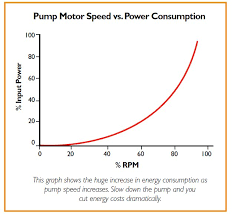 The Energy Using Products directive from the EU implies amongst other things that from 1 January 2015, all electric motors from 7.5-375 kW must either meet the IE3 standard or the IE2 standard equipped with a variable frequency drive (VFD).
Grundfos supported this initiative, as well they might and credit is due (in general).
However, there is also significant scope for this specific requirement to cause an environmental disaster...
This sounds rather alarmist - it is, I am sounding an alarm!
However it also requires that I justify my position.
As we see on the left slowing a pump just a little from 100% - 60% of maximum may reduce energy consumption by 80%
This is not to be sneezed at.
But system efficiency is another question - and it is the only question that matters from an environmental perspective.
If we consider the most common application of pumping it is in the movement of energy contained in hot heating services or cold chilling services water.
A pump capable of moving megawatts of heating water (powered say by gas boilers or furnaces) may be pumped by a few kilowatts.
Under these conditions reducing the pumping rate saves some kilowatts, but may have repercussions on the supply of megawatts of services.
But is this likely?
Lets see what the International Energy Agency have to say on the subject:
IEA (experiences in Swedish District Heating) (Abstract)
In practice, the achievement of large temperature differences is counteracted by mal-functions of consumer stations and their components and often also by short circuits in the distribution network, leading to higher return temperatures and in general also to increased supply temperatures compared to what would be desirable. Additionally, system designers have very often built-in over-dimensioned "reserve capacities" leading to non-optimal functions of control instruments. The results of such malfunctions are higher pumping losses, higher return and supply temperatures and therefore higher heat losses from the net. In the worst case, the net can be choked at the high load times and will not be able to deliver the necessary design power.
What does this mean?
OK - Imagine you are controlling the mixing of hot and cold water running into your bath in some cheap motel. The hot water is scalding hot (unnecessarily) and so you keep the hot tap pretty much closed at all times. All the other guests do the same. So what happens is very little very hot water is used, and as a result the motel saves pumping costs with their new variable speed drive (for the technically alert I am assuming an open system so local pumping is related to water flow delivered).
BUT - a smart new engineer comes along and says,
"HEY - I have a better idea - If we lower the water temperature, we will save on gas, and less heat will leak out of the hot pipes into the areas we are cooling. Naturally, guests will use a bit more water, which will put up our pumping costs, but these are negligible vs our heating costs."
Our new engineer is using the variable speed drive as a feedback mechanism to better control provision of the primary service "heat", by ensuring that the VSD never works as intended (ie operates near maximum rated output - where there are nearly no electrical savings) he maximizes system efficiency and hence environmental impact. In other words, generally the best VSD is one that is not installed as intended !
Conclusion
Where-ever a VSD is fitted, without a smart engineer like our fictional character above, at times of low load, simple thermostatic control efficiency is jeopardized, because the returning temperature of hot or cold water services is no longer indicative of the demand for those services.
Simple return temperature sequencing of boilers and chillers as recommended almost universally for simple system control by Best Practice (to overcome the single weakest point in any building with multiple boilers - the matching of supply to demand), becomes not a simple panacea, but an unstable control system with an inherently non-linear destabilizing positive feedback mechanism built in.
And that is a Environmental Disaster - not one that is waiting to happen, but one that is already well underway !
Update : There is good reason for use of appropriate technologies when adequately understood and outlined here :
http://www.abb-conversations.com/2012/11/three-steps-to-improve-compressor-energy-efficiency/trackback/
